Fractal Pixel

Fractal Pixel

This brochure needs WebGL 2. Please open it in a current browser.
The idea

Up close, a pattern. From a distance, an image.

Fractal Pixel is a surface of light whose pixels are meant to be seen. A pattern divides the surface into cells, and every cell is a pixel with a shape, an edge and a presence of its own. Stand close and you read the pattern: cell, wall, material, the geometry of the light. Step back and the same cells resolve into an image. The surface is designed for both readings.

It is not a screen hiding behind an image. It is architecture that happens to be programmable: a façade, a wall, a ceiling or a door that keeps its character switched off and becomes a medium switched on. And it is one idea at every scale, from a small cell lit from behind to a large cell built as its own box of light, from a whole façade to a single object with everything built in.

The content belongs to the pattern. Light moves cell by cell, runs along the joints and takes the shape of the geometry. The surface never shows a picture laid over it: the pattern itself moves, and the pixel keeps its character in motion.

Fractal Pixel is designed and built parametrically. Cells, walls and light are generated from the geometry, so a new pattern is not a new product but a new expression of the same surface: drawn for a place, a brand or a single building.
Pattern, content, distance.

This is the surface itself, live. Choose the pattern that divides it into cells, choose what the cells show, and move closer or further away to see the two readings. Drop a video or an image of your own to see it through the cells.

Pattern
Content
far
180 mm
— pixels on screen— mm cell
drag to look around · pinch or ctrl + scroll to move closer
Drop a video or an image
This screen needs WebGL 2.
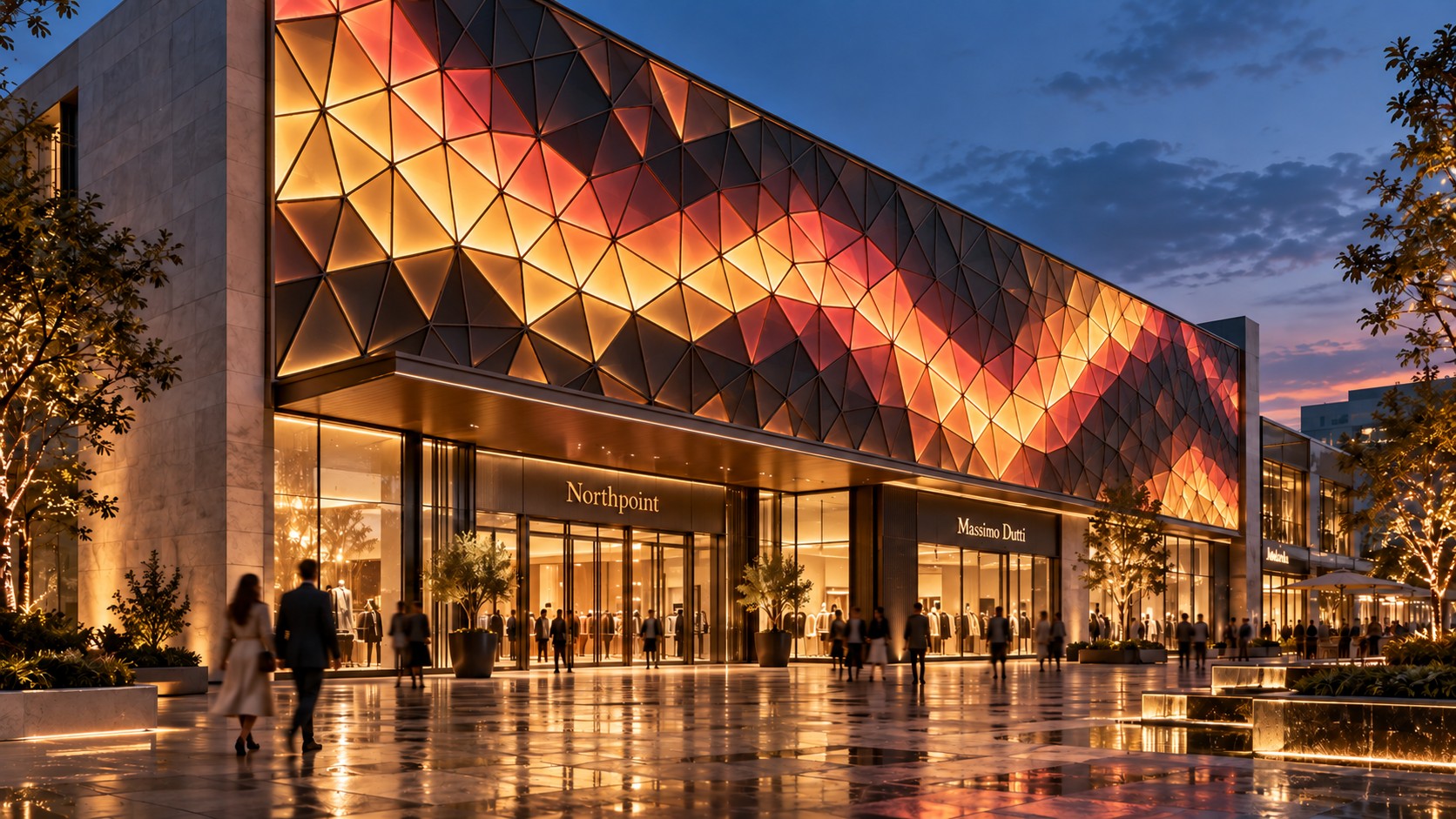
A façade clad in large luminous triangular cells, seen from the street at dusk
Large format

The cell becomes a box of light.

Large pixel for large surfaces. Each cell is built as its own box of light, lit from its walls rather than from behind. Façades, large halls, big volumes: the surface reads as architecture first and as an image second.

Large format · build

The cell as a box of light.

Above a certain size the cell stops being part of a panel and becomes its own box of light. The pattern is computed over the whole façade: every cell is different, and every one is built the same way.

  1. 01

    The facade

    The pattern is computed over the whole surface at once. Every cell is different; nothing repeats.

  2. 02

    The cell

    Zoom in on any cell: a polygon of its own. From here on, every cell follows the same steps.

  3. 03

    The cut sheet

    Back plus one flap per side, cut flat as a single piece. The cell edges are the fold lines.

  4. 04

    The fold

    The flaps fold up into the walls. Back and sides come out of the same sheet.

  5. 05

    The light

    An analogue LED strip runs the inside perimeter and lights the cell sideways. The cell is one pixel.

  6. 06

    The diffuser

    A diffuser closes the front, flush with the walls. The cell is sealed.

  7. 07

    The back

    Fixing points where the battens will pass behind the cell, and one sealed cable with its connector.

  8. 08

    The substructure

    A battened facade: the battens carry the cells and open a cavity behind them. A trunk cable drops between the battens, with a branch and a connector for every cell. The cell hooks over two battens and plugs in.

  9. 09

    In place

    Cell after cell, the facade fills up. Every cell a different box; every box the same build.

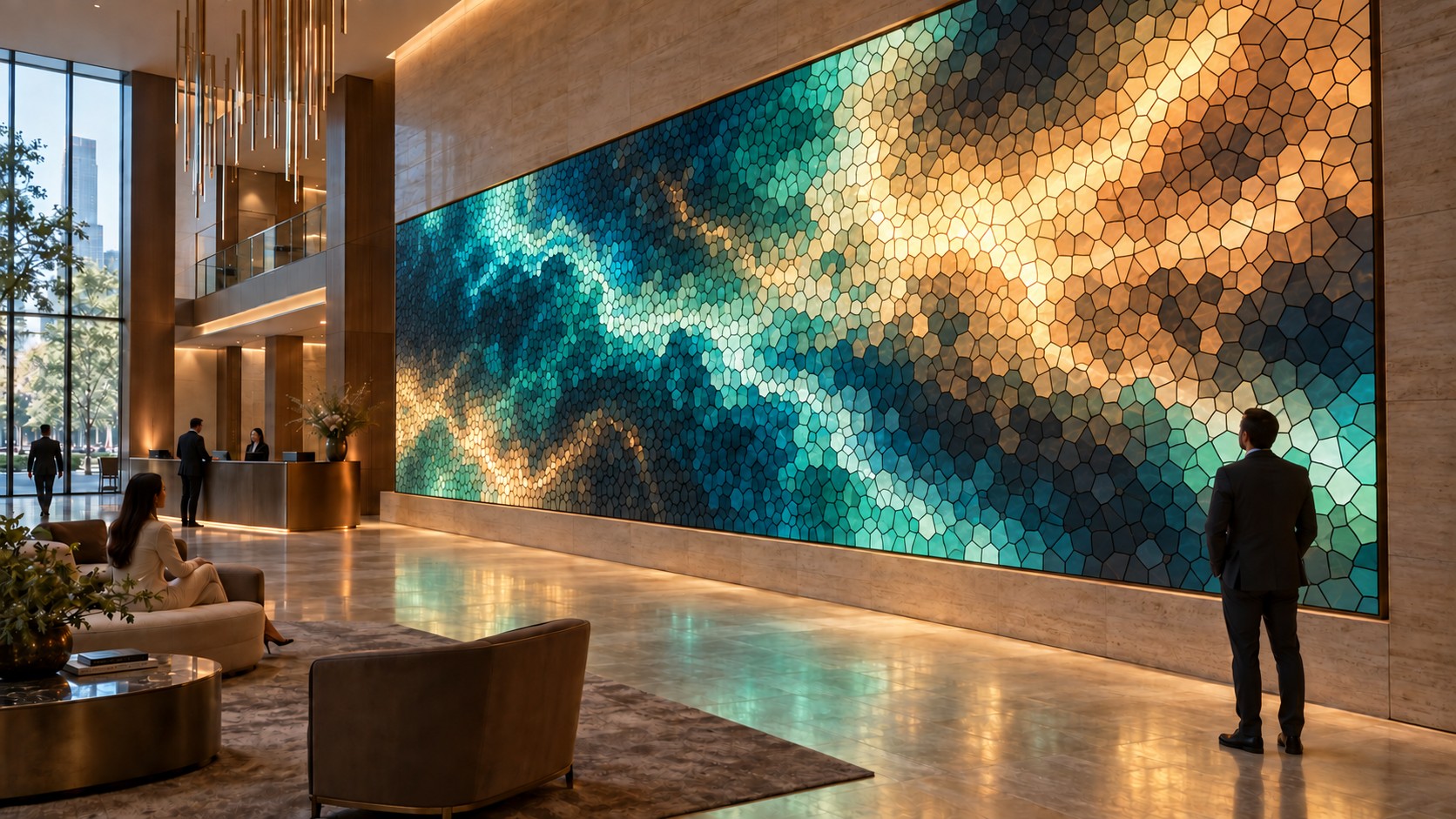
A hotel lobby wall clad in a continuous luminous Cellular surface at storey height
Interior panel

The baseline of the system.

Small pixel on a panel. Cells lit from behind, and panels that tile into one continuous surface with no visible grid. Walls and ceilings at storey height, where the content becomes legible and black holds as a material of its own.

Patterns

Six patterns to start from.

Every pattern is a geometry of closed cells, and every closed cell is a pixel. These six are the starting points. The surface is designed and built parametrically, so each of them can be resized, and new ones can be drawn for a project.

Cellularparametric

Irregular cells of similar area. No two alike, no visible repeat: the most organic reading.

Polygonalparametric

Triangles that change size and direction. Sharper and more crystalline; the corners carry the light.

Trapezoidgeometric

Two orientations on one lattice. From a distance it reads as a weave.

Hexgeometric

The regular one. Even and calm, the most legible for content.

Cushiongeometric

Curved cells. The pattern is drawn as much by the black between the cells as by the light.

Khatamheritage

Eight-point stars and unequal cells. The geometric heritage of the Gulf, and the proof that the geometry can be anything.

Parametric by design

Cells, walls and light are generated from the geometry. Change the pattern, the cell size or the wall, and the panel, its LED layout and its mapping follow.

Modular by construction

Panels tile into one continuous surface with no visible grid, and every panel type is one fixture in the control system. A custom pattern is a new panel, not a new project.

This brochure needs WebGL 2. Please open it in a current browser.