Reed
Lights

Wind-responsive luminaires

Tuzzaro dsg
Drag to change the wind
01 — Concept

Light that
moves with
the air

Reed Lights start from an observation: in a landscape, the things that read as alive are the ones that move. A reed bends under a gust, returns, and bends again. Never twice the same way.

Each luminaire is a slender flexible stem carrying a single warm point of light. There are no motors and no moving parts. The movement is real: the stem is engineered to deflect within a defined envelope and to recover, so the field breathes with the weather actually on site.

By day the reeds are a fine graphic line against the sky. By night they become a low horizon of warm light at 2,700 K and Ra 97, close enough to firelight that the eye reads it as warm rather than as lit.

02 — Anatomy

The synergy between design
and engineering

Born with the wind, this luminaire has a narrow path. The proportion has to work at every size, and the structure has to flex. Materials are selected for endurance in the open and for how the luminaire reads at any distance. Every part is drawn to please the eye and to hold the physics.

01 / 05
—
—
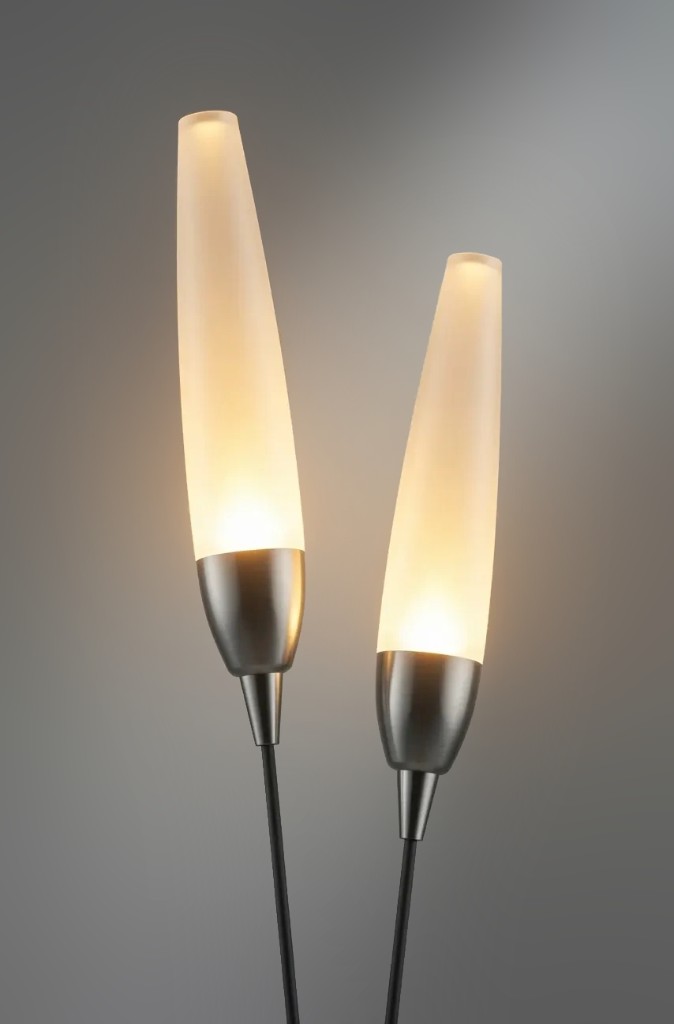
Reed head detail
RL-8.5RL-7.25RL-6.0RL-4.5RL-3.5RL-1.0RL-C5
03 — Family

Two families,
one silhouette

The range is two families. Reed Light XL is the architectural scale: five individually anchored heights, from a plaza-holding 8.5 metres down to 3.5. Reed Light S is the landscape scale — the same gesture in small format, planted as a cluster or as an individual on a base or a spike.

Every size shares one silhouette, so mixed groupings read as a single planting rather than as a kit of parts.

RL-8.5
04 — Reed Light XL

The
architectural
scale

Above three metres the reed stops being landscape and becomes architecture: it holds the vertical dimension of a plaza without the mass of a column. A duplex stainless sleeve carries it through reachable height — structural where it must be, invisible where it need not be — and hands over to a tapered glass-fibre stem that is free to move above.

05 — Reed Light XL

How it moves

First-mode deflected shape, arc length conserved. Deflection grows with the square of wind speed, so the reed is quiet in a breeze and expressive in a gust — and the taller the reed, the further it travels.

Static deflections under steady wind, figures for the RL-8.5. Under gusts the reed overshoots the static position, crosses the vertical and returns — the movement the eye reads is larger than the figures above.
06 — Reed Light S

The landscape
scale

At ground level the reed becomes planting: a carbon whisker with a warm seed of light, small enough to grow in drifts between stone and grass. Reeds are planted in small clusters that share a single root, so a whole field dims and breathes as one.

The result is a field: hundreds of warm points at knee height that shift and blur as you move through them.

07 — Reed Light S · Configurations

Spike, base & cluster

Single reed, ground spike
Pushed into sand or soil on its spike, cable buried, spacing set by eye. A single reed is never used alone. It is one voice of a larger, organic planting.
Single reed, circular base
Set on the ground on a circular aluminium disk, cable through the plate. For sand and soft ground, where a spike will not hold.
Cluster
Five Reed Light S of mixed heights on one plate. The angle lives in the plate, sockets opening gradually outwards, so the gesture is repeatable and the stems stay simple.
08 — In place

Where the
reeds live

Arrival courts, promenades, plaza edges, planted islands. The reeds work best where there is air to move them and a dark ground to read them against.

09 — Specification

Technical data

Reed Lights

Qiddiya Resort — Resort Core Public Realm · Packages 01 & 12
Original concept design
Lighting Design Collective
Product development & supply
Tuzzaro dsg
Typologies
Reed Light XL — 3,500 to 8,500 mm
Reed Light S — 300 to 1,000 mm, clusters of five
Enquiries